


Choosing Pond Liners for Heavy-Duty Water Containment Projects 💧
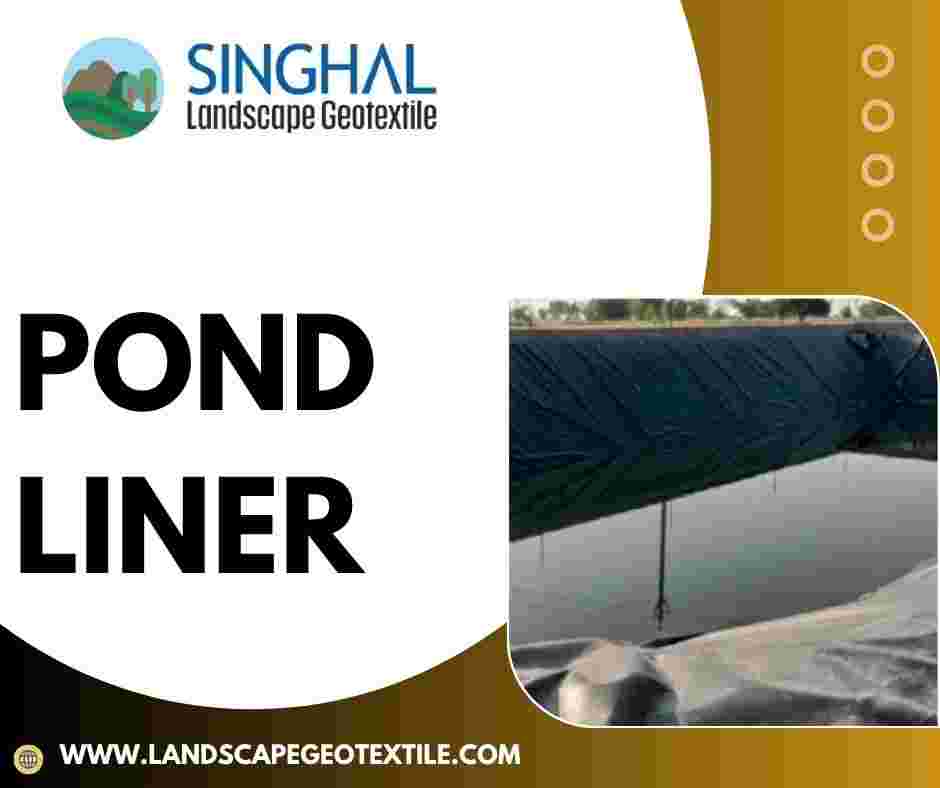
Heavy-duty water containment projects such as large agricultural reservoirs, commercial aquaculture farms, municipal water storage basins, or demanding industrial effluent ponds need a level of strength and dependability that is more than that of a typical backyard garden pond. The proper pond liner selection is probably the most vital decision in these undertakings because the total success and duration of the containment structure depend on the liner's capacity to refrain from punctures, to endure environmental conditions, and to be chemically inert. A thorough review of material specifications, liner thickness, and local conditions is involved in this decision.
Material Matters: Identifying the Best Pond Liner Material
When the robust and durable containment of a project is a priority, the Best pond liner material choice is mostly limited to two main alternatives: High-Density Polyethylene (HDPE) and Reinforced Polyethylene (RPE).
HDPE liners are strong, resistant to chemicals, and stable under UV light. They are made of thermoplastic material and therefore, HDPE is the standard for the most challenging and large-scale applications like landfills, mining heap leach pads, and large water storage reservoirs. The tight structure of it makes it very difficult for water or chemicals to pass through and also a great protection against the penetration of roots and a large range of chemicals. Although it is hard and can be difficult to install in small, complex-shaped ponds, its strong nature makes it the right choice for large, geometric basins that are the most common in heavy-duty containment.
RPE, or Reinforced Polyethylene, is generally referred to as the most suitable material when the requirement for strength and low weight is balanced. The substance consists of a fabric scrim (a reinforcing mesh) that is inserted in between two layers of a polyethylene film, thus making the material have very high resistance to tearing and puncture even though it is relatively thin. RPE is not as heavy as HDPE, so it is easier to carry and handle on the ground. Besides, RPE usually is produced in larger ready-made pieces, which means fewer field seams and thus less time required for installation and less possibility of leak points. In consequence, RPE is the most common material for farming or environmental projects where a long lifespan and high puncture resistance are the main requirements. As for the rest, materials such as EPDM (Ethylene Propylene Diene Monomer) perform very well in small, flexible ponds but generally lack the necessary tensile strength and chemical resistance for heavy-duty applications.
The Critical Factor of Thickness
The Best pond liner thickness cannot be defined as a single universal value, rather it depends on the particular requirements of a project. Thickness is usually expressed in millimeters (mm) or mils (1 mil = 0.001 inches), and it is directly related to the ability to resist puncture, the general durability, and price.
In the case of heavy-duty containment, the general rule is that the greater the thickness the better the performance. While light-duty applications might be carried out with 20 mil (0.5 mm) or 30 mil (0.75 mm) liners, professional, high-stress projects are usually at least 40 mil (1.0 mm) and from there thicknesses grow considerably. It is extremely important to decide on the correct thickness for a pond liner in cases such as large water reservoirs, industrial wastewater, or areas with highly abrasive subgrades, thus, it is quite common to come across 60 mil (1.5 mm), 80 mil (2.0 mm), or even 100 mil (2.5 mm) HDPE specifications. This upgrade in thickness gives a much higher safety margin against threats that are specific to the site. For instance, a 60 mil HDPE liner is a kind of standard for municipal and industrial applications where environmental regulations require maximum leak protection.
Site Preparation and Underlayment
Regardless of the best pond liner material or Best thickness for pond liner, its lifespan depends on the correct installation which is preceded by the subgrade. In heavy-duty cases, the pond bottom needs to be very well prepared, all the rocks, roots, and sharp debris that can damage the liner have to be removed.
Besides, it is almost impossible to do without a high-quality underlay if one wants to completely protect a liner. The protective layer in question is normally a kind of non-woven geotextile material and its role is to serve as a buffer between the subgrade and the liner. The use of a particular product, such as a Singhal Landscape geotextile, is usually advised. The non-woven fabric serves a number of important roles: it stops the movement of very fine soil particles (filtration and separation), it spreads the pressure coming from hydrostatic forces or the cover material (cushioning), and, above all, it shields the geomembrane from holes caused by sharp stones or roots that may grow in the future. The geotextile should be a heavy-duty one with at least 8 oz/sy (about 270 GSM) for a rocky or an aggressive subgrade.
Heavy-duty projects often times bring along the situation where the elements can eat away at the standard materials that are used. Industrial containment or specific agricultural applications may have the effect of the liner being exposed to chemicals, effluents, or even high concentrations of salts. In such a situation, the chemical resistance of the liner material against the stored liquid has to be first of all confirmed. Usually, the chemical compatibility of HDPE and RPE is on a higher level than that of PVC or EPDM.
Along with this, continuous exposure to ultraviolet (UV) radiation from the sun is what worries all outdoor containment projects the most. The best pond liner material, in fact, should be made by mixing high proportions of carbon black to provide maximum UV stabilization, which is one of the main features of strong HDPE and RPE liners. In case the liner is going to be exposed (not covered by the soil or rock armor), it is very important to make sure that it has at least 2% carbon black content if you want it to last for a long time.
Conclusion
The decision of choosing a pond liner for heavy-duty water containment is a very profound one which determines the success, compliance, and future operating expenses of the project.
An evaluation of the application will very much assist in making the decision of whether to use one or the other of the high-performance materials such as HDPE or RPE. The ideal pond liner thickness for those kinds of critical situations normally varies from 40 mil to 80 mil or even more. This material will have to be used along with a very careful subgrade preparation and the wise utilization of a top-notch non-woven geotextile like the Singhal Landscape geotextile in order to be completely and permanently protected against punctures.
By thoroughly engaging in the matter of material composition, demanded thickness, and subgrade preparation, engineers and contractors are able to provide a durable, leak-proof, and long-lasting solution for containment.
Frequently Asked Questions (FAQs)
Q: What is the best pond liner material for a massive, non-decorative water containment reservoir?
A: Materials that are made of High-Density Polyethylene (HDPE) and Reinforced Polyethylene (RPE) are the most recommended for those kinds of projects that use a large amount of water and require heavy six/environmental friendly discharge capacity, due to factors of mechanical and physical durability like strength, resistance to UV rays, and the compatibility with usage of different chemicals. Besides, RPE can be selected frequently as it has an extraordinary resistance to penetration and weighs lesser.
Q: What is the best thickness for pond liner in industrial wastewater applications?
A: The recommendation in general for industrial wastewater is that the minimum thickness of a pipe liner should be at least 60 mil (1.5 mm) and made of HDPE in order to be highly resistant to chemicals and to adhere to strict regulatory standards that are aimed at leak prevention. If the case is extremely dangerous or high-impact projects, they may impose the thickness to be 80 mil or even 100 mil.
Q: Is a geotextile underlayment truly necessary for heavy-duty liners?
A: Indeed, it is an absolute necessity to have an underlayment. Even if the thickness of the best pond liner is considered, it can still be damaged by sharp protrusions of the ground underneath or by the growth of roots. Items such as a Singhal Landscape geotextile help to provide the necessary layer of protection as well as separation, thus, they greatly prolong the life and impunity of the main geomembrane.
Q: What is the average lifespan of a heavy-duty HDPE pond liner?
A: If the installation is done properly, the duration of high-quality HDPE (40 mil and more) liners that have been UV-stabilized may reach from 20 to 50 years, especially when they are layered with a protective soil layer.
Q: Can a non-fish-safe liner be used in agricultural irrigation ponds?
A: The answer is affirmative. Should the water be used only for irrigation, then the "fish-safe" certification would be a redundant one. Nonetheless, the majority of materials that are designed for heavy-duty use such as HDPE and RPE are non-toxic and may be regarded as safe water storage vessels that are intended for plant and livestock consumption.
Q: What are the key advantages of RPE over standard HDPE for large projects?
A: The main feature of RPE (Reinforced Polyethylene) is that, as compared to HDPE, it has a much greater tensile strength and much better puncture resistance although it is thinner. Apart from that, the material is lighter, and there are very few large pre-fabricated panels from which it is made, thus, the number of on-site seaming operations is decreased which, in its turn, installation is sped up.
Q: Who is the largest supplier of Pond Liner?
A: Global and regional market leadership are very dynamic. Nevertheless, after the acquisition of GSE and TenCate by Solmax International, the company along with the major manufacturers in India like The Supreme Industries, Emmbi Industries Ltd., and Singhal Landscape Geotextile which are the largest suppliers, offering a wide range of products including heavy-duty HDPE and RPE liners, are in the lead.
Q: Who is the largest exporter of Pond Liner?
A: Large-scale geosynthetics manufacturers such as BPM Geosynthetics, Solmax International, and various others mainly from countries with significant manufacturing capabilities in Asia and North America are the major global exporters. Besides, many Indian companies like Singhal Landscape Geotextile. and Welpack Industries Pvt. Ltd., have a widening international presence exporting a considerable volume of their HDPE and other geomembrane products.
Q: Who is the largest manufacturer of Pond Liner?
A:The single largest manufacturer globally changes over times, but Solmax International is generally considered the leading one in volume worldwide. The Supreme Industries (with its Silpaulin brand), Emmbi Industries Ltd., and Singhal Landscape Geotextile. are among the largest manufacturers in the Indian market, producing a substantial amount of pond liners for both domestic and export consumption. Singhal Industries is a company that is famous for the production of a wide range of products, for example, its geomembranes and Singhal Landscape geotextile that are mostly used together in containment projects.

 English
 French
 Spanish
 Portuguese
 Deutsch
 Turkish
 Dutch
Dutch
 Italiano
 Russian
 Romaian
 Portuguese (Brazil)
 Greek
Greek
