


What Is Travelling Microscope? Principle, Working Guide
In physics and engineering laboratories, precision measurement is critical. One such highly accurate instrument used for linear and angular measurements is the travelling microscope. If you’ve ever wondered what a travelling microscope is and how professionals take accurate travelling microscope reading, this guide explains everything in simple terms.
Whether you are a student, lab technician, or researcher, understanding this instrument can significantly improve measurement accuracy in experiments.
What Is Travelling Microscope?
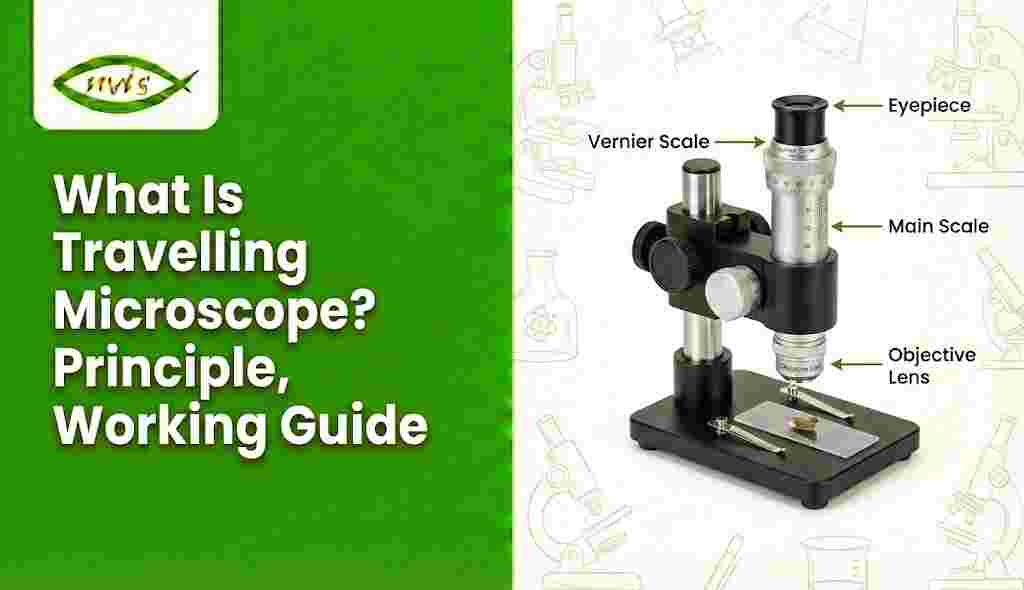
A travelling microscope is a precision optical instrument used to measure very small distances with high accuracy. It consists of a microscope mounted on a movable carriage that slides along a graduated scale.
The instrument moves horizontally (and sometimes vertically), allowing users to observe and measure minute displacements in experiments such as:
-
Refractive index determination
-
Surface tension experiments
-
Spectrometer measurements
-
Small object thickness measurement
Traveling Microscope is an extensively used product in Research, Colleges, Schools and Industrial laboratories for accurate measurement of the diameters of different objects. Two slow motion knobs are provided for taking accurate readings. For placing objects on a horizontal stage, a milky cenolite sheet is provided on the base. The position of the Microscope can be varied coarsely by sliding along the rails, or finely by turning the screw. The microscope is focused by rack and pinion, and has achromatic objective of 50mm focal length and eye piece with cross line graticule. The purpose of the microscope is to aim at reference marks with much higher accuracy compared to bare eyes .It is used in labs to measure refractive index of liquids using the geometrical concepts of Ray Optics. It is also used for accurate determination of small variation in the liquid levels, the refractive index of liquids as well as in surface tension & diameter of capillary tubes with precision.
Main Parts of a Travelling Microscope
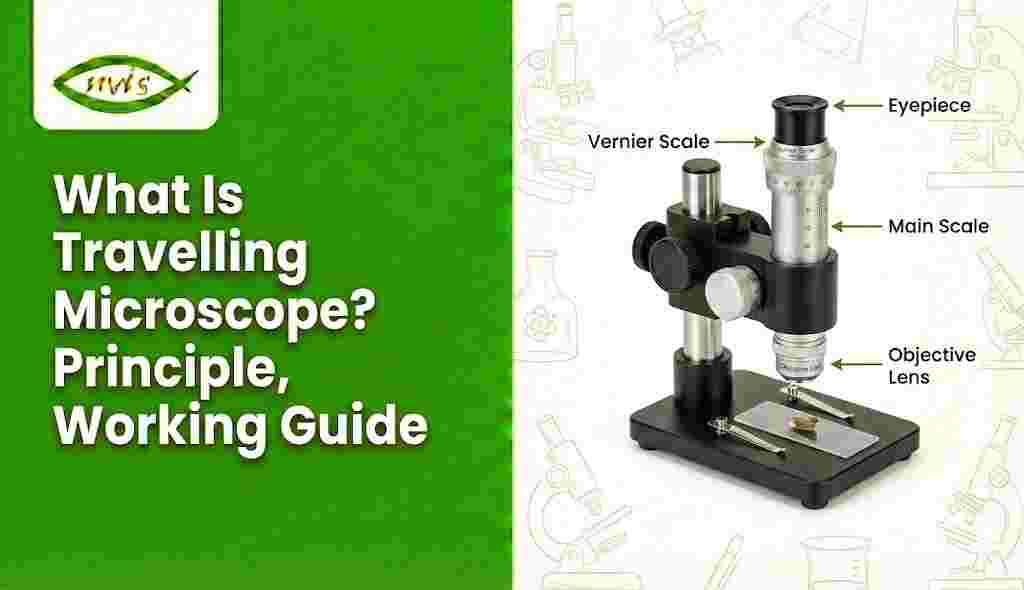
Understanding the parts helps in taking accurate travelling microscope reading:
-
Main Scale – Graduated in millimeters.
-
Vernier Scale – Used for fine measurement (improves accuracy).
-
Microscope Tube – For magnified observation.
-
Focusing Knob – To obtain a clear image.
-
Horizontal & Vertical Movement Screws – For controlled movement.
-
Base with Leveling Screws – Ensures stability.
Principle of Travelling Microscope
The working principle is based on:
-
Vernier scale measurement technique
-
Magnification for precise alignment
-
Accurate linear displacement measurement
The vernier scale allows readings up to 0.01 mm (depending on least count), making the instrument extremely precise compared to standard rulers.
How to Take Travelling Microscope Reading
Taking a correct travelling microscope reading requires careful observation and proper alignment. Since the instrument measures very small distances, even a slight mistake can affect accuracy. Follow the steps below to ensure precise measurement.
Step 1: Focus the Object
First, adjust the microscope using the focusing knob until the object or reference mark appears sharp and clear. Make sure the cross-wires are properly aligned with the point you want to measure. Proper focusing helps eliminate parallax error and improves accuracy.
Step 2: Note the Main Scale Reading
Observe the main scale carefully. Record the reading that appears just before the zero of the vernier scale. This value is called the Main Scale Reading (MSR) and is usually measured in millimeters.
Step 3: Note the Vernier Scale Reading
Next, look at the vernier scale and find the division that exactly coincides with a division on the main scale. Count the number of that coinciding division. This gives the Vernier Scale Reading (VSR).
Step 4: Apply the Formula
Use the standard formula:
Final Reading = Main Scale Reading + (Vernier Reading × Least Count)
Example Calculation
-
Main Scale Reading (MSR) = 12.5 mm
-
Vernier Coinciding Division = 8
-
Least Count = 0.01 mm
Now apply the formula:
Final Reading = 12.5 + (8 × 0.01)
Final Reading = 12.5 + 0.08
Final Reading = 12.58 mm
Applications of Travelling Microscope
The travelling microscope is widely used in:
-
Physics laboratories
-
Optical experiments
-
Engineering colleges
-
Research labs
-
Surface tension measurement
-
Newton’s rings experiment
-
Measuring small diameters
Its precision makes it essential in experiments requiring micrometer-level accuracy.
Conclusion
Now you clearly understand what a travelling microscope is and how to take accurate travelling microscope reading. This instrument plays a crucial role in precision measurements in physics and engineering labs.
From measuring minute displacements to conducting optical experiments, the travelling microscope remains one of the most reliable laboratory tools for high-precision measurement.
If you're working in a lab environment or studying instrumentation, mastering this instrument will greatly enhance your practical skills.
Learn about the travelling microscope, its principle, working, reading method, least count, and applications in physics and optical experiments.
 Portuguese
 English
 Arabic
 French
 Spanish
 Deutsch
 Turkish
 Dutch
Dutch
 Italiano
 Russian
 Romaian
 Portuguese (Brazil)
 Greek
Greek
