


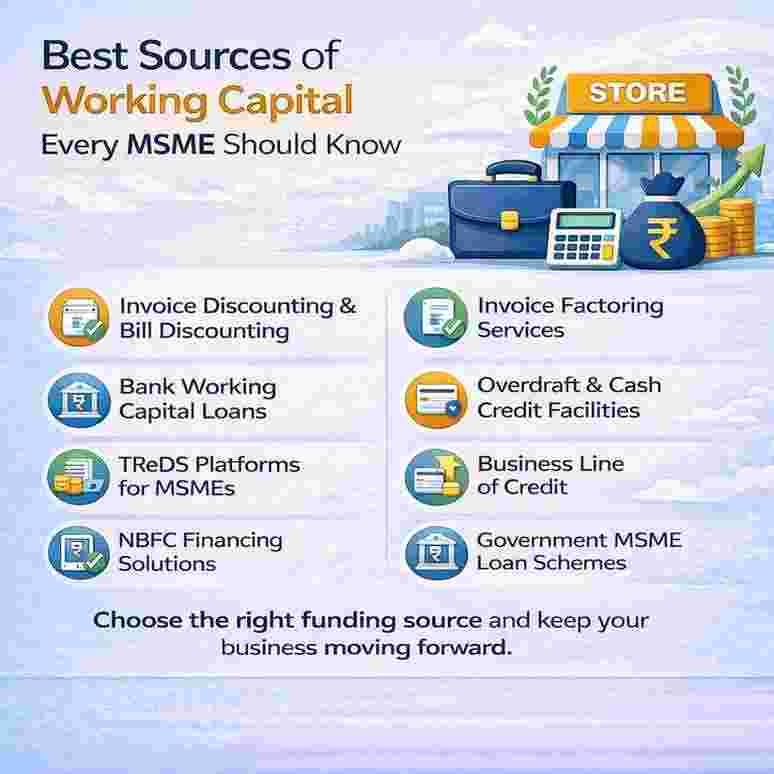
Best Sources of Working Capital Every MSME Should Know
Working capital is essential for the smooth functioning of any business. For MSMEs in India, managing day-to-day expenses such as raw material purchase, salaries, rent, and operational costs depends heavily on steady cash flow. However, delayed payments and limited access to credit often create financial pressure.
Understanding the best sources of working capital every MSME should know can help businesses choose the right funding option and avoid cash flow issues. In this blog, we explore the most effective working capital sources available in India, with a strong focus on invoice discounting through Receivables Exchange of India Limited (RXIL), one of the most reliable platforms for MSMEs.
1. Invoice Discounting Through RXIL
Invoice discounting is one of the most efficient ways for MSMEs to access working capital. It allows businesses to convert unpaid invoices into immediate cash instead of waiting for the payment cycle to complete.
A leading platform in this category is RXIL (Receivables Exchange of India Limited), which operates under the Trade Receivables Discounting System (TReDS) framework introduced by the Reserve Bank of India.
How It Works
-
MSME raises an invoice on a corporate or government buyer
-
The buyer approves the invoice on the platform
-
Financiers bid to offer funds
-
MSME receives early payment
-
Buyer pays the financier on the due date
2. TReDS Platforms
TReDS platforms such as RXIL also help MSMEs raise funds through invoice discounting.
Benefits
-
Transparent digital platform
-
Access to multiple financiers
-
Faster funding against invoices
-
Helps manage receivables efficiently
These platforms are suitable for MSMEs supplying to large corporates and government buyers.
3. Bank Working Capital Loans
Traditional bank loans remain a common source of working capital for MSMEs. Banks offer products such as:
-
Cash credit (CC)
-
Overdraft (OD)
-
Short-term business loans
These loans help businesses manage daily expenses and maintain liquidity.
Advantages
-
Lower interest rates compared to some alternatives
-
Structured repayment plans
-
High loan amounts
Limitations
-
Requires collateral in many cases
-
Lengthy approval process
-
Strict eligibility criteria
Despite these challenges, bank loans continue to be an important funding option.
4. NBFC Financing
Non-banking financial companies provide flexible working capital solutions to MSMEs that may not qualify for bank loans.
An example is NeoGrowth, which offers business loans based on cash flow.
Benefits
-
Faster approval process
-
Flexible eligibility
-
Quick disbursement
NBFCs are a good alternative for businesses that need quick funds without extensive documentation.
5. Fintech Lending Platforms
Fintech platforms have made it easier for MSMEs to access working capital through digital channels.
Companies like Lendingkart and FlexiLoans offer quick loans with minimal paperwork.
Advantages
-
Fully online application
-
Fast approval and disbursement
-
Minimal documentation
-
Suitable for small businesses
Fintech lending is ideal for MSMEs with urgent funding needs.
6. Invoice Financing Platforms
Invoice financing platforms allow businesses to sell their receivables to investors in exchange for immediate funds.
KredX is a well-known platform in this space.
Benefits
-
No collateral required
-
Quick access to funds
-
Based on invoice value
This option is suitable for businesses with strong buyer relationships.
7. Trade Finance for Exporters
Export-oriented MSMEs can use trade finance solutions to manage working capital.
Drip Capital provides financing against export invoices.
Advantages
-
Supports international transactions
-
Helps maintain cash flow
-
Often collateral-free
Trade finance is useful for businesses involved in global trade.
8. Business Credit Cards
Business credit cards are another source of short-term working capital. They help manage daily expenses such as travel, office supplies, and utility payments.
Benefits
-
Easy access to credit
-
Interest-free period (if paid on time)
-
Helps manage short-term expenses
However, high interest rates apply if payments are delayed.
9. Government Schemes for MSMEs
The Indian government offers several schemes to support MSME financing.
These include:
-
Mudra loans
-
Credit Guarantee Fund Trust for Micro and Small Enterprises (CGTMSE)
-
Startup India initiatives
Benefits
-
Reduced collateral requirements
-
Lower risk for lenders
-
Support for small businesses
Government schemes are helpful for startups and small enterprises with limited resources.
10. Equity Funding and Investors
MSMEs and startups can also raise working capital by bringing in investors.
This includes:
-
Angel investors
-
Venture capital firms
-
Private equity
Advantages
-
No repayment obligation
-
Access to large capital
-
Strategic guidance from investors
However, businesses need to share ownership and control.
How to Choose the Right Source of Working Capital
Selecting the right funding option depends on several factors:
-
Business Size and Stage: Startups may prefer equity funding, while established MSMEs may use invoice discounting or loans.
-
Urgency of Funds: For immediate needs, invoice discounting and fintech lending are more suitable.
-
Cost of Financing: Compare interest rates or discounting charges before choosing a source.
-
Risk and Collateral: If you want to avoid collateral, platforms like RXIL and invoice financing options are better.
Why RXIL Stands Out
Among all the sources listed above, Receivables Exchange of India Limited stands out as one of the most efficient and MSME-friendly working capital solutions.
Key Reasons
-
Operates under RBI-regulated TReDS framework
-
Enables competitive bidding by financiers
-
Provides fast and reliable access to funds
-
Reduces dependency on traditional loans
-
Supports MSMEs dealing with large buyers
RXIL helps businesses unlock the value of their receivables and maintain steady cash flow without taking on additional debt.
Conclusion
Managing working capital is critical for the survival and growth of MSMEs in India. With multiple financing options available today, businesses have more flexibility in choosing the right source based on their needs.
From traditional bank loans to fintech lending and invoice discounting, each option has its own advantages. However, platforms like Receivables Exchange of India Limited (RXIL) provide a modern, efficient, and transparent way to access funds by converting unpaid invoices into immediate cash.
For MSMEs facing delayed payments, RXIL offers a practical solution that improves liquidity, reduces financial stress, and supports business growth.
FAQs
1. What is working capital and why is it important for MSMEs?
Working capital is the money a business needs to manage its daily operations, such as paying salaries, purchasing raw materials, and covering operational expenses. For MSMEs, maintaining sufficient working capital is important to ensure smooth business operations and avoid cash flow issues.
2. What are the top sources of working capital for MSMEs in India?
Some of the top sources include invoice discounting platforms like Receivables Exchange of India Limited, bank loans, NBFC financing, fintech lending platforms, trade finance, and government schemes. Each option serves different business needs depending on urgency and eligibility.
3. How does invoice discounting help MSMEs raise working capital?
Invoice discounting allows MSMEs to convert their unpaid invoices into immediate cash. Platforms like Receivables Exchange of India Limited enable businesses to receive early payments from financiers, improving cash flow without waiting for long credit periods.
4. Is collateral required to get working capital for MSMEs?
Not always. While traditional bank loans may require collateral, options like invoice discounting, fintech lending, and some government schemes allow MSMEs to raise funds without pledging assets.
5. Which is the best working capital solution for MSMEs in India?
The best solution depends on the business requirement. For MSMEs dealing with large buyers and facing delayed payments, invoice discounting through platforms like Receivables Exchange of India Limited is considered one of the most efficient and reliable options.
 French
 English
 Arabic
 Spanish
 Portuguese
 Deutsch
 Turkish
 Dutch
Dutch
 Italiano
 Russian
 Romaian
 Portuguese (Brazil)
 Greek
Greek
