


What to Do If Your Kojonup Home Has Bad Wiring
This isn’t coming from a big company or a sales pitch. It’s based on real experience with older homes around Kojonup-the good, the bad, and the stuff that can actually be dangerous.
Old Kojonup wiring is something a lot of people don’t think about until there’s a problem.
Getting a residential electrician Kojonup homeowners trust —like Salty Creek Electrical to check things properly can make a big difference to safety and staying within the rules.
Here’s a simple look at what to watch for and why it matters.
How Do I Know If My Home Has a Problem?
You do not need a multimeter or a fancy tool. Your house will tell you something is wrong. You just have to listen.
Here are the things I hear from homeowners all the time:
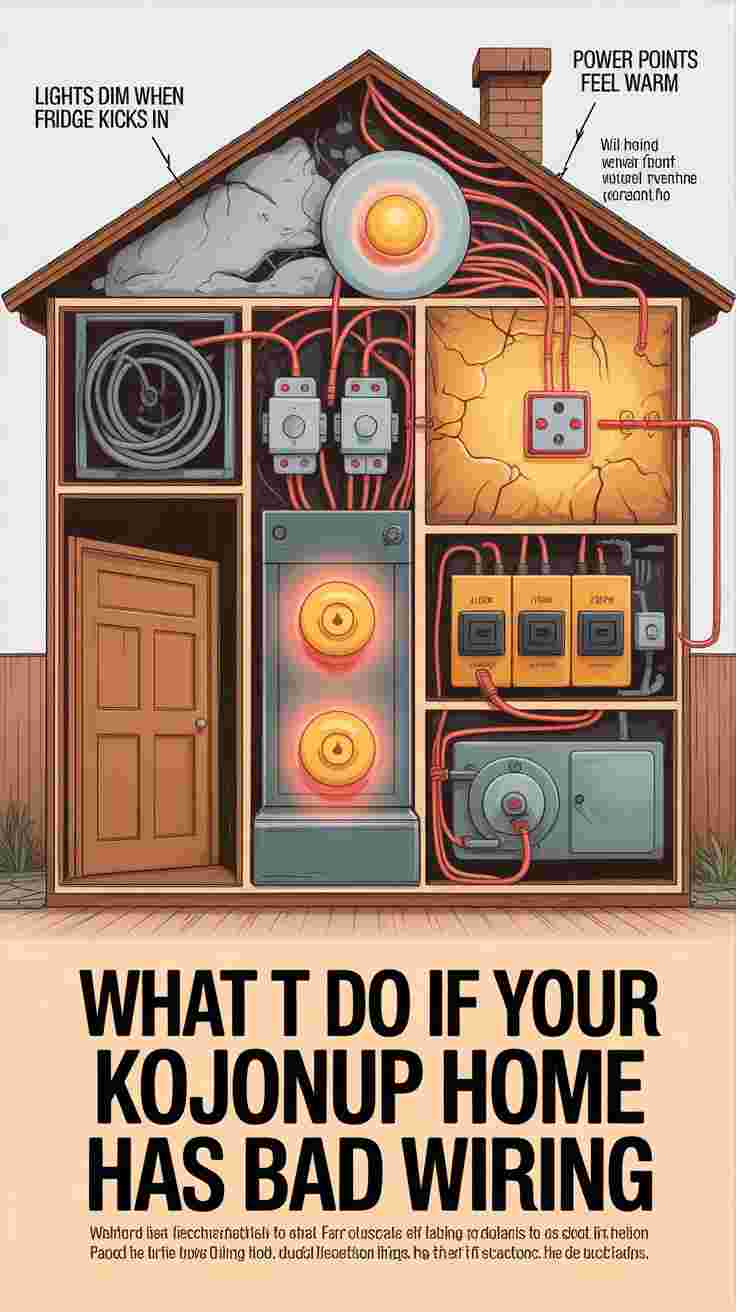
· “The lights dim when the fridge kicks in.” That is not normal. That means your wiring is struggling to carry the load.
· “One of my power points feels warm.” Stop using it right now. Call someone. Warm outlets mean loose connections or arcing inside the wall. That is how house fires start.
· “I still have those old ceramic fuses with the wire.” Mate, that system belongs in a museum, not in your home. Those things offer almost no protection against electric shock.
· “Sometimes there is a funny smell. Like fish or burning plastic.” Do not ignore this. Turn off your power at the main switch and get someone out there immediately. I am not joking.
· “Our safety switch trips every time it rains.” That means water is getting into your wiring somewhere. It could be a cracked fitting outside or a roof leak. Either way, it is dangerous.
If you nodded along to any of those, please keep reading.
The Wiring Types That Keep Me Up At Night
I have pulled out a lot of old wiring in Kojonup. Some of it is just outdated. Some of it is genuinely terrifying.
Rubber insulation (1950s and 60s) – Back then, they wrapped wires in rubber. Rubber does not last forever. Inside your walls, that rubber has turned hard and cracked. In some places, it has turned into dust. That leaves bare copper touching your timber frames. Timber plus electricity equals fire.
VIR (Vulcanised Indian Rubber) – Fancy name. Same problem. This stuff is so brittle that if you touch it, it falls apart. I have seen it crumble just from someone walking in the roof space.
Aluminium wiring (1970s) – Someone thought this was a good idea back then. It was not. Aluminium expands when it gets hot and shrinks when it cools down. It does this every single day. Over the years, this movement loosens the screws at your power points and light switches. Loose screws cause arcing. Arcing causes sparks. Sparks inside your walls cause fires.
If your home has any of these, you are sitting on a problem. Not maybe. Definitely.
What Does The Law Actually Say?
Look, I am not a lawyer. But I know the wiring rules. We call them AS/NZS 3000. Every licensed electrician in Australia has to follow them.
For your home to be legal and safe, here is what you need:
· Safety switches on every single circuit. These things save lives. If you touch something live, the safety switch cuts power faster than a heartbeat. Old fuse boxes do not have these.
· Proper earthing. Your metal pipes, your metal frames, your metal switchboards. All of it needs to be connected to the earth. Otherwise, a fault could make your tap or your fridge live.
· Separate circuits for lights and power points. This is just common sense. If your power points trip, you still want your lights on so you are not standing in the dark.
· Hardwired smoke alarms that talk to each other. If one goes off in the laundry, every alarm in the house goes off. That gives you time to get out.
This is not red tape. This is stuff that keeps people alive.
What Actually Happens During A Full Rewire?
I know the word "rewire" sounds scary. You think I am going to smash holes in every wall and leave you with dust everywhere. That is not how it works.
Here is the real process.
Step one – I come and have a look. I crawl under your house. I poke my head into your roof space. I figure out where the old cables run and where the new ones can go without wrecking your plaster.
Step two – I check for asbestos. A lot of Kojonup homes from the 70s and 80s have asbestos sheeting in the walls or ceilings. If that is there, we have to be careful. There are rules about how to handle it safely.
Step three – I run the new cables. I use the existing gaps. I fish cables down cavities. I cut small access holes where I have to, but I patch them up properly. You will barely know I was there.
Step four – The switchboard gets replaced. Your old fuse box comes off the wall. A new one with safety switches and circuit breakers goes up. This usually means turning off power to the whole street for a little while. Your neighbours will survive.
Step five – New power points and switches. This is actually the nice part. You get to choose what you want. Modern ones. Vintage style ones. Ones with USB ports built in. Whatever works for you.
A full house usually takes me three to five days. Depends how big your home is and how tricky the access is.
Can I Keep My Old House Charm?
Yes. A hundred times yes.
I work on old homes all the time. People love their original light fittings and their old ceiling roses. I get it. They look beautiful.
You can buy reproduction switches that look exactly like the old brass or ceramic ones from the 1920s and 30s. They have modern safe wiring inside but they look vintage on the outside. Best of both worlds.
We do not have to rip out your character to make your home safe.
Please Do Not Do It Yourself
I have to say this because people still try it.
Do not rewire your own house. Do not let your brother-in-law who "knows a bit about wiring" do it either.
In Western Australia, it is illegal to do unlicensed electrical work. Full stop. If you do it and your house burns down, your insurance company will laugh at you. Then they will deny your claim. Then you will be standing outside a burnt house with nothing.
And worse than that, you could kill yourself. 240 volts is no joke. I have seen what electricity does to the human body. It is not pretty.
Just hire someone licensed. That is the only way to be safe, legal, and insured.
Why You Want a Local Who Knows Kojonup
Hiring a residential electrician Kojonup matters because old rural homes are different. You have sheds. You have bore pumps. You have water heaters and shearing sheds and chicken coops. All of that needs power.
A local knows which streets have the tricky asbestos. A local knows the council rules. A local knows how to work around heritage listings.
And honestly? A local is just easier to deal with. You can call them. They show up. They know your street. They know your neighbours. That matters.
So when you are ready to sort out your wiring, look for a residential electrician Kojonup who has been doing this for years. Not a newbie. Not a handyman. Someone who has seen it all.
A Few Last Things To Ask For
When you do hire someone, ask them to include these things:
· Safety switches on every circuit (non-negotiable)
· A whole-home surge protector (saves your TV and computer)
· At least one USB outlet in the kitchen and the main bedroom
· A dedicated circuit for your air conditioner and your fridge
· Extra space in the switchboard for solar panels or a battery later
If they say no to any of those, find someone else.
Let Me Wrap This Up
Look, I am not going to scare you into spending money you do not have. But I am going to be honest with you.
Old wiring does not fix itself. It gets worse. Every summer, every storm, every time you turn on the heater, those old cables get a little more tired. A little more dangerous.
You do not have to rewire everything tomorrow. But at least get someone to come and check it. Pay for a safety inspection. It costs a couple hundred bucks and it might save your life.
I have been in too many Kojonup homes where the owners said "we will get to it next year." And then next year came, and something bad happened.
Do not be that person. Your family is worth more than that.
Take care. Stay safe. And if you smell something funny coming from your power point, please, just turn it off and call someone.
A quick note from me: This is just honest advice based on what I have seen working in Kojonup homes. I am not your electrician unless you hire me. Every home is different. Always get a licensed professional to look at your specific situation before making any decisions. Stay safe.
 English
 Arabic
 French
 Spanish
 Portuguese
 Deutsch
 Turkish
 Dutch
Dutch
 Italiano
 Russian
 Romaian
 Portuguese (Brazil)
 Greek
Greek
