


Projection Welding: Principle, Process, Applications & Industrial Advantages | Heron Welder
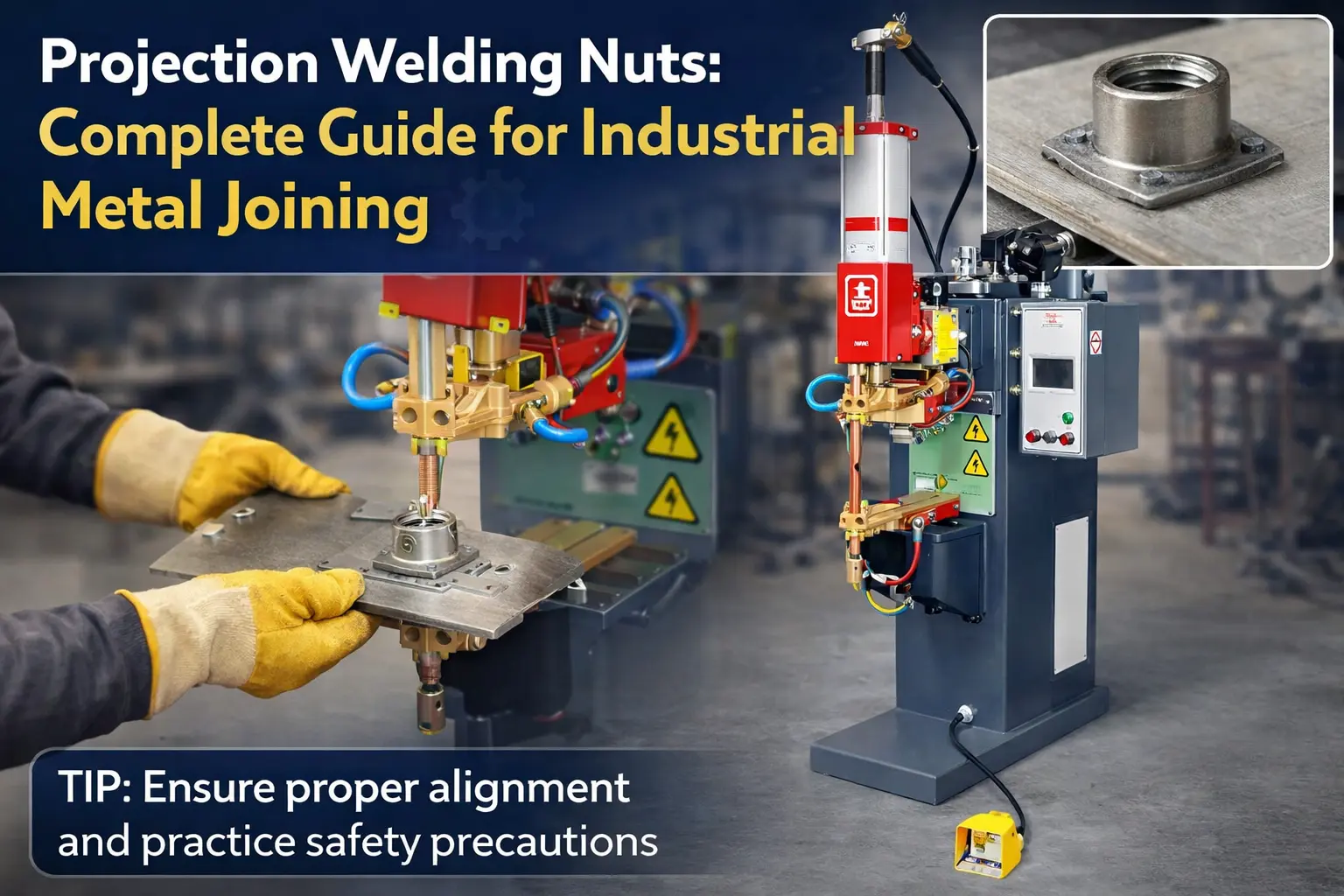
In modern manufacturing, where precision, repeatability, and cycle time directly impact profitability, projection welding has become one of the most reliable resistance welding techniques for high-volume metal joining. From automotive body assemblies to electrical components and heavy industrial fasteners, this process ensures strong, consistent joints with minimal distortion and excellent automation compatibility.
At Heron Welder, we design advanced resistance welding systems that enable manufacturers to achieve stable, high-efficiency production using projection welding across diverse industrial applications.
What is Projection Welding?
Projection welding is a resistance welding process where small raised features called projections are intentionally formed on one workpiece surface. When current and pressure are applied through electrodes, these projections concentrate heat at precise points, creating localized weld nuggets that bond the materials together.
Instead of relying on electrode shape (as in spot welding), projection welding uses the part geometry itself to define the weld location. This makes the process highly repeatable and ideal for automated production lines.
Working Principle of Projection Welding
The process is based on three core factors: current, pressure, and resistance concentration.
- Positioning of Workpieces
Two metal parts are placed between flat electrodes, one containing projections (dimples, ribs, or rings). - Current Flow & Heat Generation
Electric current passes through the projections, where resistance is highest, generating intense localized heat. - Projection Collapse & Fusion
As temperature rises, projections soften and collapse under pressure, forming a solid weld nugget. - Solid-State Bond Formation
After cooling, a strong metallurgical bond is formed at each projection point.
Multiple projections can be welded simultaneously, significantly improving production efficiency.
Types of Projection Welding
1. Embossed Projection Welding
- Uses stamped dimples or raised patterns
- Common in sheet metal assemblies
- Ideal for automotive panels and brackets
2. Solid Projection Welding
- Uses machined or forged projections
- Common in fasteners like weld nuts and studs
- Suitable for thick or high-strength materials
Key Advantages of Projection Welding
Projection welding is widely preferred in industrial manufacturing because it offers:
- High production speed (multiple welds in one cycle)
- Excellent repeatability
- Minimal electrode wear
- Precise weld location control
- Reduced surface marking
- Easy automation integration
Unlike conventional spot welding, projection welding enables better current distribution control and reduces dependency on electrode shaping.
Industrial Applications of Projection Welding
Projection welding is extensively used across high-volume manufacturing industries:
Automotive Industry
- Seat frames
- Body-in-white assemblies
- Welded nuts, bolts, and brackets
Electrical & Electronics
- Battery terminals
- Contact points
- Conductive connectors
Heavy Engineering & Fabrication
- Structural steel components
- Industrial fasteners
- Sheet-to-frame assemblies
Appliance Manufacturing
- Compressor mounts
- Motor housings
- Reinforcement brackets
Its ability to join multiple points simultaneously makes it ideal for mass production environments requiring consistent weld quality.
Projection Welding vs Spot Welding
While both are resistance welding processes, they differ significantly:
- Heat Source
- Spot welding: electrode concentrates heat
- Projection welding: workpiece projections concentrate heat
- Weld Control
- Spot welding: dependent on electrode shape
- Projection welding: controlled by part design
- Production Efficiency
- Projection welding allows multiple welds in a single cycle
- Electrode Life
- Projection welding reduces electrode wear due to larger contact area
This makes projection welding more suitable for fasteners, precision assemblies, and automated production lines.
Best Practices for High-Quality Projection Welding
To achieve stable weld quality, manufacturers should focus on:
- Consistent projection geometry (height, shape, spacing)
- Proper surface preparation (clean, oxide-free surfaces)
- Optimized electrode force and current balance
- Accurate alignment of components
- Controlled weld time and hold time
- Use of MFDC or capacitor discharge systems for precision control
Advanced systems with programmable controllers significantly improve repeatability and defect reduction.
How Heron Welder Supports Projection Welding Excellence
At Heron Welder, we specialize in industrial-grade resistance welding and automation solutions, including:
- Projection welding machines
- MFDC resistance welding systems
- Automated welding production lines
- Custom welding guns and controllers
- Integrated fastening and assembly systems
Our engineering approach focuses on precision control, energy efficiency, and production scalability, enabling OEMs and manufacturers to achieve higher output with consistent weld integrity.
Whether you are building automotive assemblies, electrical systems, or heavy industrial components, our projection welding solutions are designed to integrate seamlessly into your production environment.
FAQs About Projection Welding
1. What materials are suitable for projection welding?
Steel, stainless steel, aluminum alloys, and coated metals are commonly used, depending on machine capability and projection design.
2. Why are projections used in welding?
Projections concentrate electrical resistance, ensuring heat is generated exactly where the weld is required.
3. Can projection welding be automated?
Yes, it is widely used in robotic and automated production lines due to its repeatability and multi-point welding capability.
4. Is projection welding stronger than spot welding?
In many applications, yes. It provides more consistent weld nugget formation and better control over weld location.
5. Where is projection welding most commonly used?
It is widely used in automotive manufacturing, electrical components, appliance production, and metal fabrication industries.
Conclusion
Projection welding is a highly efficient and precise resistance welding method that supports modern industrial production demands. Its ability to deliver consistent multi-point welds, reduce cycle time, and improve automation compatibility makes it essential for manufacturers aiming for high-quality mass production.
With advanced engineering and automation expertise, Heron Welder delivers reliable projection welding solutions tailored for demanding industrial environments.
Looking for a Custom Projection Welding Solution?
Contact Heron Welder today to explore customized projection welding machines, automated systems, and turnkey production solutions designed to enhance your manufacturing efficiency and product quality.
 Deutsch
 English
 Arabic
 French
 Spanish
 Portuguese
 Turkish
 Dutch
Dutch
 Italiano
 Russian
 Romaian
 Portuguese (Brazil)
 Greek
Greek
