


Types of Enzymes Used in Laundry Detergents
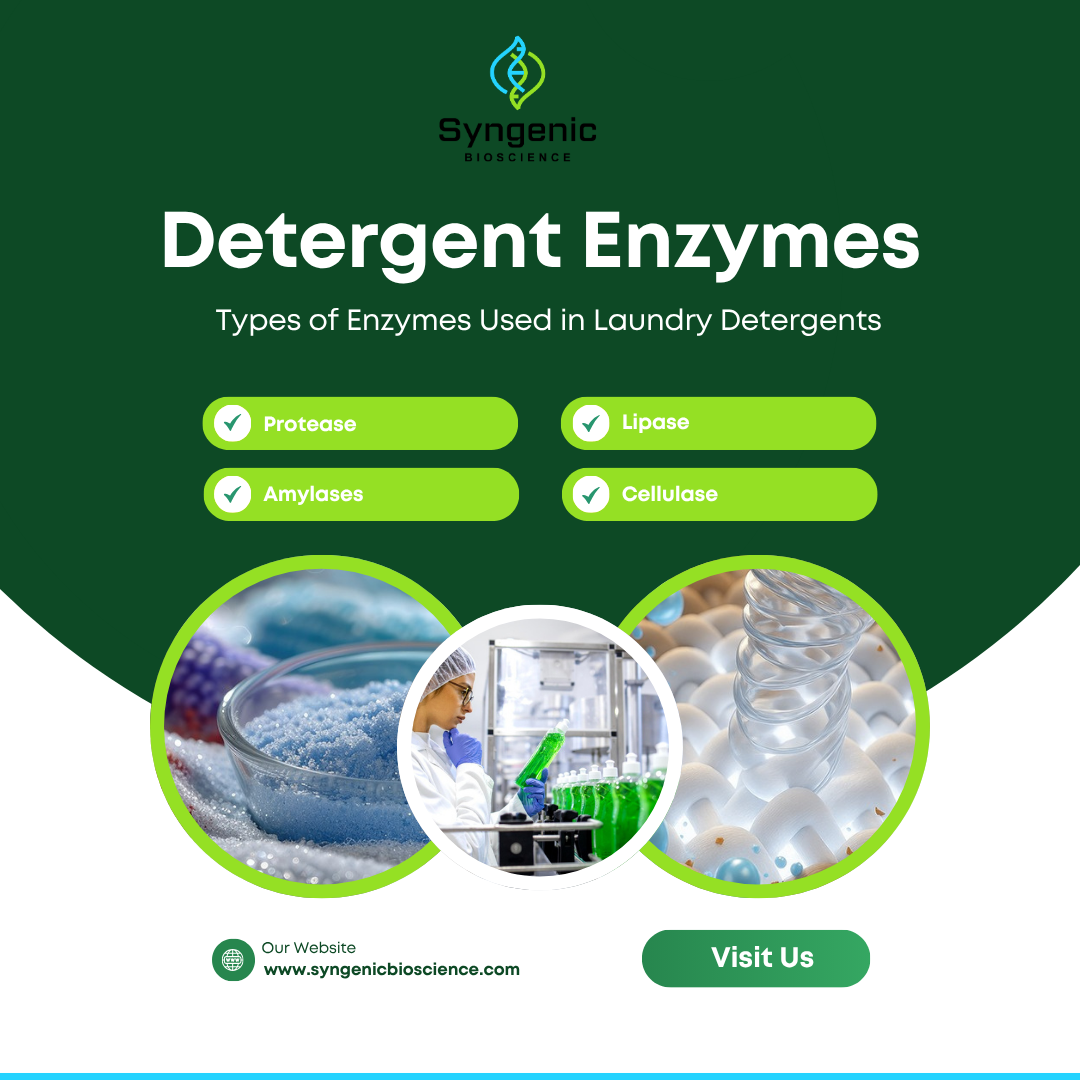
Detergent Enzymes
Laundry detergents have come a long way since they were first introduced. It began as a very basic soap-like substance and has now evolved into a highly advanced cleaning agent that is not only safe for use on clothes but is also effective in cleaning stubborn stains. The detergent enzymes represent one of the most important advancements in modern day cleaning products. These natural biological catalysts boost the cleaning power of detergents and make it possible for them to clean different types of stains very well.
The detergent enzyme manufacturers are now working on making detergent enzymes that will focus on breaking down proteins, lipids, starches and other common stains on fabrics. Knowing the different types of enzymes in detergents makes it easier to comprehend how efficient the laundry detergents of today are even when washing at lower temperatures.
Why Enzymes Are Used in Laundry Detergents?
One of the reasons why enzymes are present in laundry detergents is that they assist in breaking down the complex structures of stains into smaller particles that the water easily removes. Enzymes act very differently and efficiently than chemical reactions since they utilize a variety of reactions that are all considered to be weak depending on the enzyme used. Most of the enzymes that you will find in any given laundry detergent have been made in such a way that they will ruin various types of stains that can be found on fabric. Some of these stains include food, oil, and sweat.
Every enzyme targets a specific type of organic material for its breakdown. Besides that, the feature of detergents with enzyme technology allows them to work effectively in both hot and cold water. It not only helps in conservation of energy but also ensures excellent cleaning results. So, detergents with enzymes have become a popular choice for home and laundry.
Main Types of Detergent Enzymes
There are different types of enzymes in detergents, and each enzyme removes a different type of stain. These can be included in the laundry detergent. Some of the enzymes commonly included in laundry detergents are protease, amylase, lipase, and cellulase.
Protease
Protease is one of the most widely used detergent enzymes in laundry formulations. Egg, dairy products, and grass are examples of protein-based stains. These stains contain proteins and are removed by protease enzymes. Such stains are normally hard to remove since they bond so well with the fabric material. However, such stains are greatly assisted in their removal by the action of protease in an enzyme-based detergent. This is because they are broken down into smaller particles and thus easily dissolve in water.
Amylases
Starch-based stains, such as those found in food products like sauces, ice cream, and baby foods, are targets for amylases. Starch is sticky, and it is hard for these molecules to leave fabrics as they tend to stick well. For amylases to make it easier for the starch molecules in fabric stains to dissolve and leave the fabric, they act by breaking down the molecules into sugars.
Lipase
Lipases are an enzyme that mainly acts on oil stains. The oil stains can be from cooking oil, butter, and human skin oil. The oil is said to be hydrophobic. Because of this property of fats and oil, it is mostly hard to clean the oil stains by the action of the detergent. Lipases are effective in removing oil from the fabric even at low temperatures.
Cellulase
The detergent enzymes are effective in breaking down the cellulose fibers in the textile. Textiles made from cotton can experience the formation of microfibrils on the surface of the cotton. This can lead to an untidy look of the cotton fabric. Cellulases can break down the microfibrils on the cotton fabrics, thus potentially increasing the lifespan of cotton fabrics.
How Enzymes Work in Laundry Detergents?
The enzymes used in laundry detergentsare based on their ability to accelerate chemical reactions. All enzymes target a particular kind of stain and can be defined as biological catalysts. The enzymes become effective and begin reacting with the stain after the detergent is mixed with water. By biological means, they decompose large particles into smaller particles.
The surfactants of the detergent cover the broken pieces of the spot and remove them from the fabric. Next, the washing machine uses water to rinse them off. Another advantage of enzymes is that they react at lower temperatures. This is another big advantage of using enzymes: they help to conserve energy, as it is possible to clean clothes using modern detergents and cold water.
Benefits of Enzyme-Based Detergents
Enzyme based detergents have several advantages over traditional formulas.
The first benefit associated with the use of an enzyme-based detergent is that it will take a significantly shorter amount of time to clean your clothing because enzymes are more effective at cleaning stains than traditional chemicals used in traditional detergent and can clean your clothing faster.
Another benefit associated with the use of enzyme-based laundry detergent is that it is energy-efficient. This implies that it will be possible to save energy as one washes their laundry because it can work well even when cold water is used.
The enzyme technique can be very effective in ensuring that your clothes look new for a longer period through the enzyme’s capability to remove dirt from your clothes quickly without any damage. In addition, there are enzymes that can ensure that your clothes retain texture, color, and look after washing.
Another factor is sustainability in terms of environmental impact. Most of the detergent enzyme manufacturers are producing liquid enzymes that are biodegradable and are being used for cleaning purposes. In this way, the environmental impact of the products is reduced.
Further, the manufacturers of the enzyme-based cleaning products are achieving better results by using environmentally friendly products compared to normal cleaning compounds.
Contact Detergent Enzyme Manufacturers
In recent times, the technology used in enzyme detergents has completely changed the way of the detergent that you use for washing your clothes. These types of enzymes in detergents, such as protease, amylase, lipase, and cellulase, work in coordination with each other in order to ensure that the stains on your clothes are removed without any damages. Just as in enzyme detergents, these enzymes used in laundry detergents help in breaking down proteins, carbohydrates, oil, etc., which act as inhibitors for cleaning. Detergent enzyme manufacturers offer wide range of environmentally friendly detergent enzymes to ensure best performance on stains.
 Deutsch
 English
 Arabic
 French
 Spanish
 Portuguese
 Turkish
 Dutch
Dutch
 Italiano
 Russian
 Romaian
 Portuguese (Brazil)
 Greek
Greek
