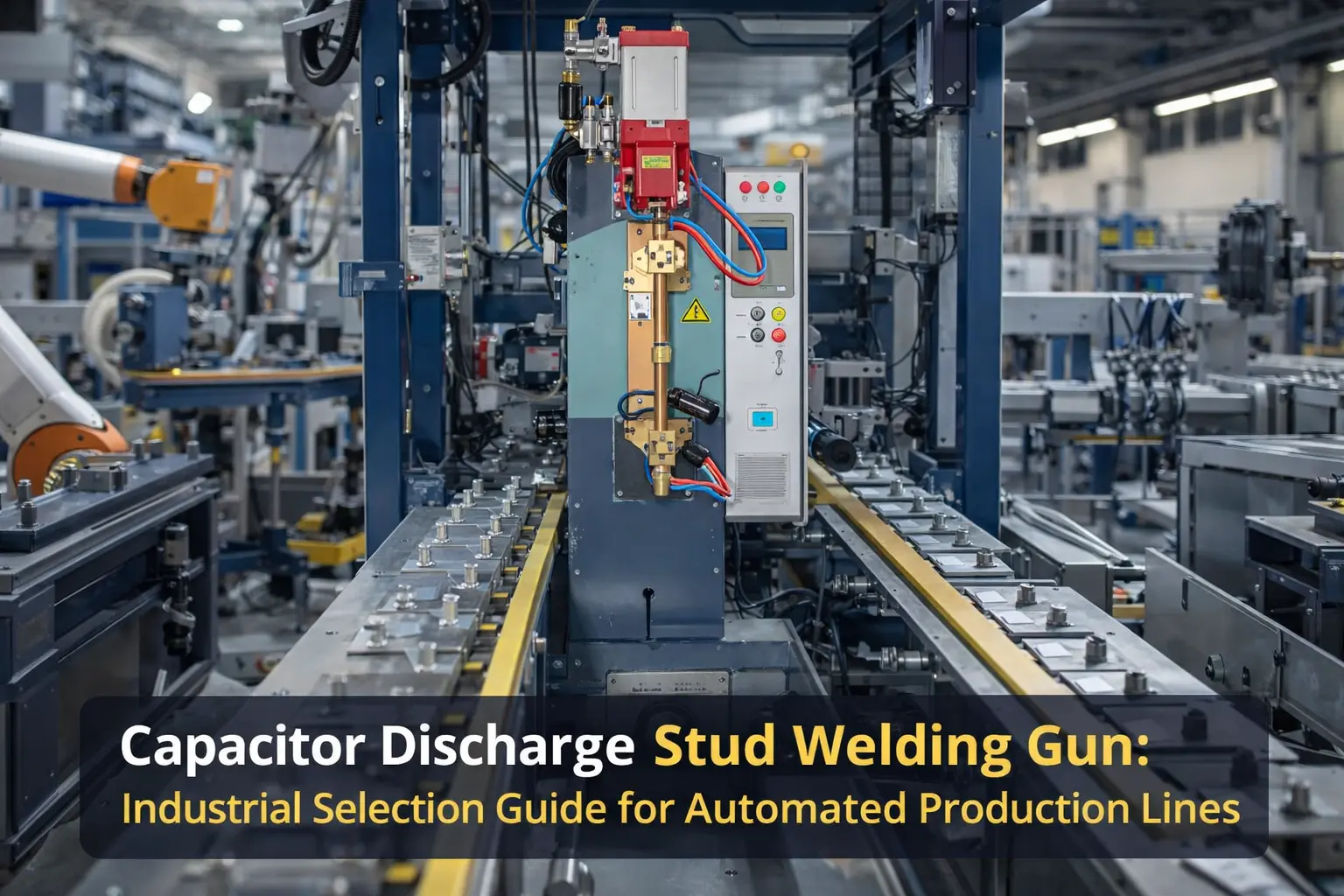
Capacitor Discharge Welding (CDW) is a highly efficient resistance welding technique designed for precision joining of metals using a rapid burst of stored electrical energy. In modern manufacturing environments especially automotive, aerospace, electronics, and heavy industrial production CDW is valued for its ultra-fast cycle times, low heat input, and exceptional weld consistency.
As global production shifts toward lightweight materials, high-strength steels, and automated assembly lines, capacitor discharge welding has become a strategic solution for OEMs and Tier-1 suppliers seeking reliability, speed, and repeatability.
At Heron Intelligent Equipment, CDW technology is engineered to deliver stable, energy-efficient, and production-ready welding systems tailored for industrial-scale applications.
What is Capacitor Discharge Welding?
Capacitor Discharge Welding is a resistance-based welding process where electrical energy is first stored in a capacitor bank and then released in a very short, high-intensity pulse to create a weld.
Instead of applying continuous current like traditional AC or MFDC welding, CDW delivers energy in milliseconds typically within 5–30 ms producing a concentrated weld with minimal thermal spread.
The basic process includes:
- Capacitors are charged with electrical energy
- Electrodes contact the workpieces
- Stored energy is rapidly discharged
- Heat is generated at the contact point
- Materials fuse under pressure
This extremely fast energy release is what makes CDW unique in industrial welding systems.
How Capacitor Discharge Welding Works (Technical Principle)
The core principle of CDW is energy storage and instantaneous discharge. The capacitor bank acts as a temporary energy reservoir. When triggered, it releases a high-current pulse that flows through the joint interface.
This creates:
- Localized heating at the weld zone
- Rapid melting or plastic deformation
- Immediate solidification under pressure
Because the energy is released so quickly, the surrounding material remains relatively cool, minimizing distortion and maintaining mechanical properties.
Modern systems, such as Heron’s medium-voltage CDW technology, are optimized for stable current curves and high repeatability, ensuring consistent weld quality even in high-volume production lines.
Key Advantages of Capacitor Discharge Welding
Capacitor discharge welding offers several advantages over conventional welding methods:
1. Extremely Short Welding Time
Weld cycles occur in milliseconds, enabling high-throughput production lines and automation-friendly operations.
2. Minimal Heat-Affected Zone (HAZ)
Because heat is highly localized, deformation and metallurgical changes are significantly reduced.
3. Energy Efficiency
Energy is only consumed during discharge, not continuously reducing overall power demand.
4. No Water Cooling Required
Many CDW systems eliminate the need for water-cooled transformers, reducing maintenance complexity.
5. High Precision and Repeatability
Stable energy output ensures consistent weld quality across thousands of cycles.
Industrial Applications of Capacitor Discharge Welding
CDW is widely used in industries where precision and speed are critical:
Automotive Manufacturing
- Welding of studs, nuts, and fasteners
- High-strength steel components
- Battery and chassis assemblies
Aerospace Engineering
- Dissimilar metal joining
- Lightweight structural assemblies
Electronics & Electrical Systems
- Copper-to-aluminum connections
- Busbars and terminals
- Sensor and micro-component welding
Heavy Industrial Equipment
- Fabricated steel structures
- High-load mechanical assemblies
CDW is especially effective for joining dissimilar metals, a growing requirement in modern lightweight engineering designs.
Capacitor Discharge Welding vs Traditional Welding Methods
| Feature |
Capacitor Discharge Welding |
AC/MFDC Resistance Welding |
Arc Welding |
| Welding Time |
Milliseconds |
Seconds |
Seconds–Minutes |
| Heat Input |
Very Low |
Moderate |
High |
| Distortion |
Minimal |
Medium |
High |
| Energy Usage |
Low |
Medium–High |
High |
| Automation Suitability |
Excellent |
Good |
Limited |
Unlike traditional welding, CDW does not rely on continuous heating. Instead, it uses a controlled energy pulse, making it ideal for precision manufacturing environments.
Best Practices for Industrial CD Welding
To achieve optimal performance in capacitor discharge welding systems, manufacturers should consider:
1. Material Compatibility
Ensure proper selection for conductive metals like steel, aluminum, copper, and their alloys.
2. Electrode Maintenance
Regular inspection reduces wear and maintains stable weld quality.
3. Energy Calibration
Fine-tuning capacitor discharge energy ensures correct penetration without over-welding.
4. Automation Integration
CDW systems perform best when integrated into robotic production lines with real-time monitoring.
5. Process Stability Control
Monitoring current curves and welding pressure improves consistency in mass production.
Heron’s CDW systems are designed with intelligent control platforms to simplify these parameters and improve production efficiency.
Why Capacitor Discharge Welding is the Future of Manufacturing
As industries move toward automation, lightweight structures, and energy-efficient production, CD welding is becoming a core joining technology.
Its advantages include:
- Faster production cycles
- Reduced operational costs
- Improved weld integrity
- Compatibility with smart factories
For OEMs and Tier-1 suppliers, CDW is not just a welding method it is a production optimization strategy.
Heron Welder: Your Partner in Advanced CD Welding Solutions
Heron Intelligent Equipment specializes in advanced resistance welding technologies, including capacitor discharge systems designed for industrial-scale production.
Our solutions focus on:
- High-performance CD welding machines
- Custom automation integration
- Stable energy discharge systems
- Long-term production reliability
Whether you are upgrading a production line or designing a new automated welding system, Heron provides engineering-driven solutions tailored to your application.
FAQs: Capacitor Discharge Welding
1. What materials can be welded using capacitor discharge welding?
CDW can join steel, stainless steel, aluminum, copper, and various dissimilar metal combinations.
2. Is capacitor discharge welding suitable for automation?
Yes, CDW is highly compatible with robotic and automated production systems due to its fast cycle time and repeatability.
3. Does CD welding require filler material?
No, capacitor discharge welding is a solid-state process and typically does not require filler materials.
4. What industries benefit most from CD welding?
Automotive, aerospace, electronics, and heavy manufacturing industries benefit significantly from CDW.
5. How does CD welding reduce heat distortion?
Because energy is released in a very short pulse, heat does not spread into surrounding material, minimizing deformation.
Final Thoughts
Capacitor Discharge Welding represents a major advancement in resistance welding technology, offering unmatched speed, precision, and energy efficiency. For manufacturers aiming to improve productivity while maintaining weld quality, CDW provides a future-ready solution.
At Heron Welder, we deliver engineered capacitor discharge welding systems designed for modern industrial challenges helping manufacturers achieve higher efficiency, better quality, and stronger production stability.
Looking to upgrade your welding process?
Contact Heron Welder today for a customized capacitor discharge welding solution tailored to your production needs.




 English
 French
 Spanish
 Portuguese
 Deutsch
 Turkish
 Dutch
Dutch
 Italiano
 Russian
 Romaian
 Portuguese (Brazil)
 Greek
Greek
