


Secondary Research Services Guide | Strategic Market Analysis & Insights
Secondary Research Services: A Complete Guide to Strategic Market Analysis
In today’s data-rich environment, businesses rarely struggle with access to information. Instead, the real challenge lies in organizing scattered data into clear, decision-ready insights. Secondary Research Services help organizations interpret existing information systematically and transform it into structured intelligence for strategic planning.
This guide explains what Secondary Research Services are, how they work, when they are used, and their advantages and limitations.
What Are Secondary Research Services?
Secondary Research Services involve analyzing existing data sources to answer business questions—without conducting new surveys, interviews, or field studies.
Rather than gathering fresh (primary) data, secondary research relies on previously published or recorded information and applies structured methodologies to extract insights.
Core Elements of Professional Secondary Research:
-
Defining the specific business objective
-
Identifying relevant and credible data sources
-
Collecting and organizing available information
-
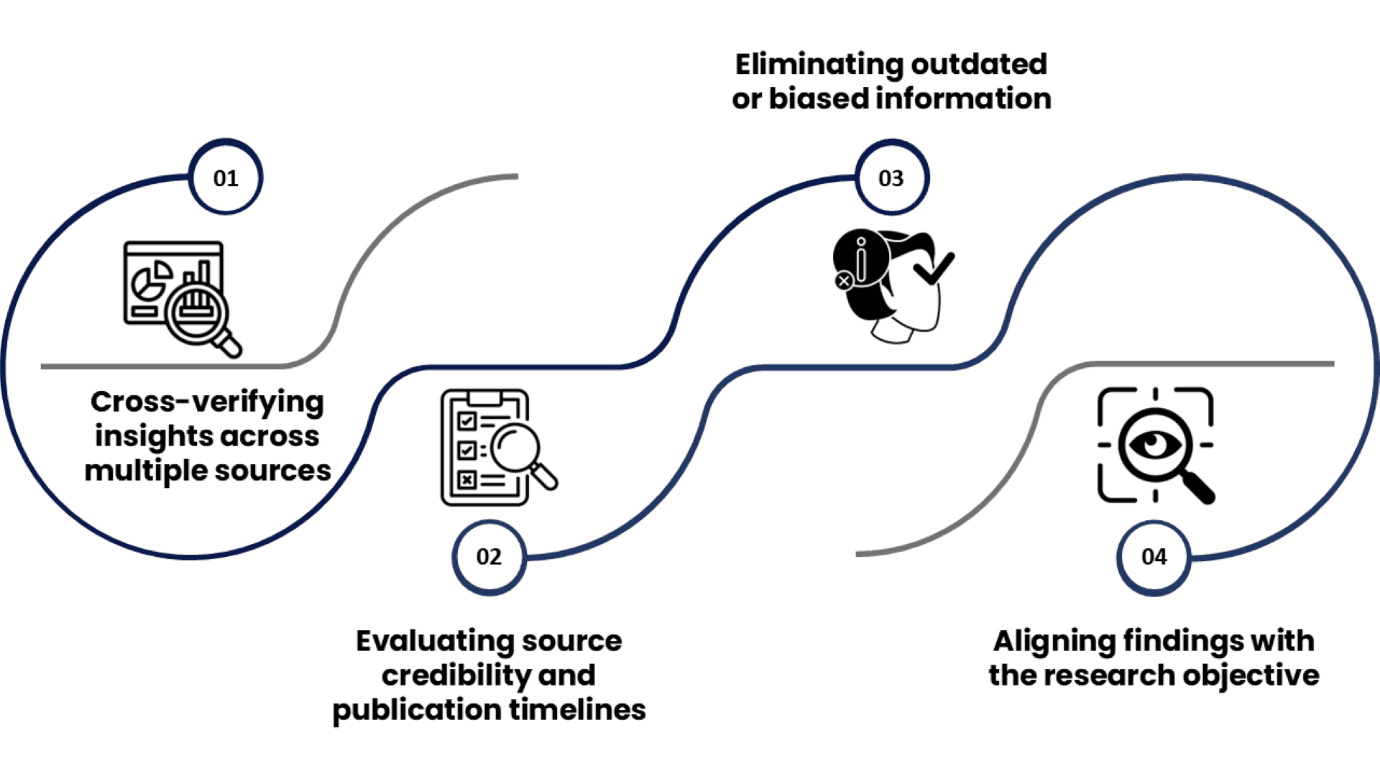
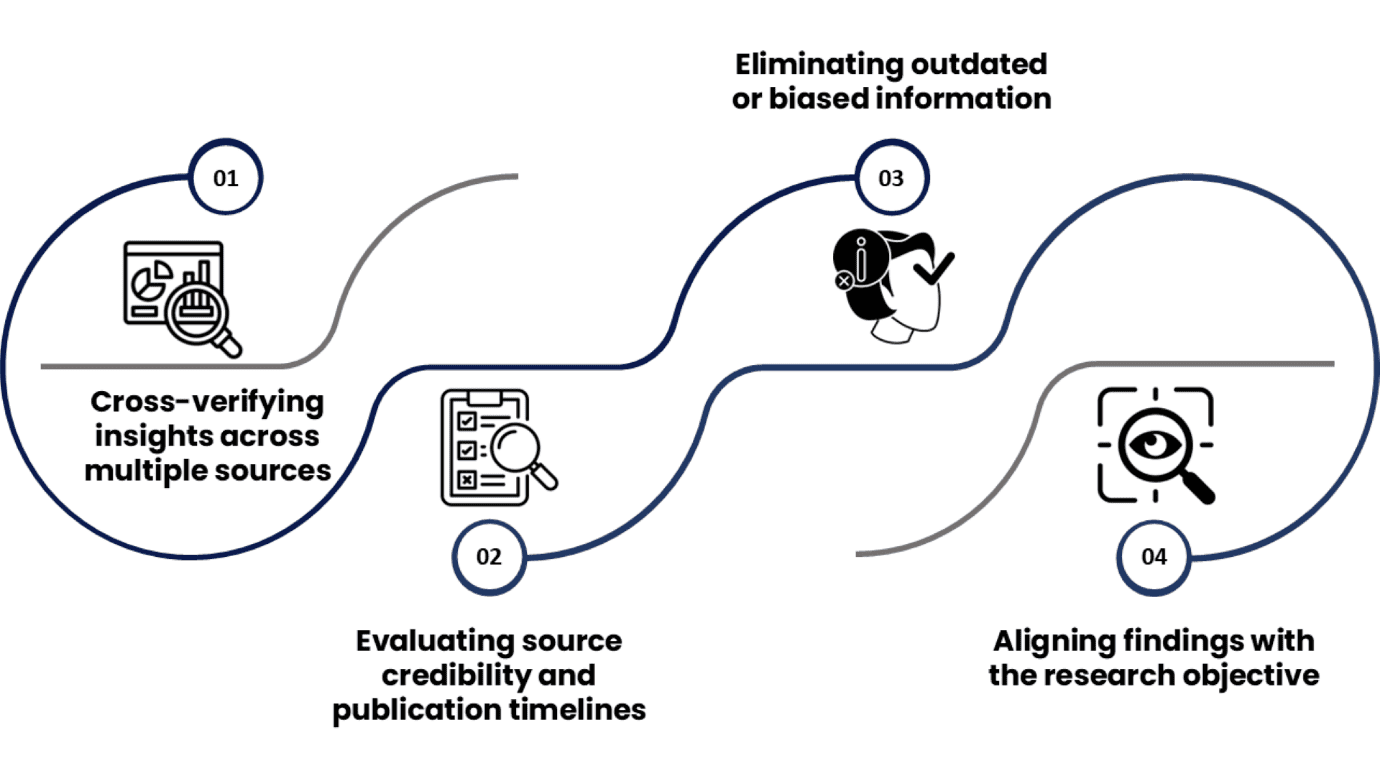
Cross-validating findings using triangulation
-
Documenting assumptions and limitations
-
Presenting structured, decision-focused outputs
The objective is not just data collection, but building reliable intelligence that supports informed decisions.
When Do Businesses Use Secondary Research Services?
Organizations typically use secondary research when they need cost-efficient, timely, and evidence-based direction.
1. Market Entry and Expansion
Before entering a new region or industry segment, companies often need clarity on:
-
Market demand and growth potential
-
Regional performance variations
-
Regulatory considerations
-
Distribution and route-to-market models
Secondary research provides an initial evidence base to evaluate feasibility before committing resources.
2. Competitive Intelligence
Secondary research helps analyze competitor activities such as:
-
Product portfolios
-
Pricing structures (where publicly available)
-
Partnerships and acquisitions
-
Hiring patterns
-
Expansion strategies
By identifying trends and signals, organizations gain a broader understanding of the competitive landscape.
3. Market Sizing and Demand Estimation
Market sizing often requires combining multiple datasets to estimate:
-
Total market value
-
Growth rates
-
Serviceable available market (SAM)
-
Serviceable obtainable market (SOM)
Where data transparency is limited, triangulation methods help create reasonable ranges and scenario models.
4. Investment and Strategy Evaluation
Investors and strategy teams use secondary research to assess:
-
Industry structure and value chains
-
Margin dynamics
-
Demand drivers
-
Structural and regulatory risks
This supports more informed capital allocation decisions.
5. Procurement and Supplier Mapping
Secondary research also supports:
-
Supplier landscape analysis
-
Certification and compliance checks
-
Capacity indicators
-
Risk screening
This allows companies to evaluate potential suppliers before initiating direct engagement.
Where Does Secondary Research Data Come From?
Reliable secondary research integrates multiple sources, including:
-
Company annual reports and investor presentations
-
Industry publications and trade associations
-
Government databases and regulatory filings
-
Import-export and trade statistics
-
Analyst commentary and market reports
-
Independent datasets and pricing indices
No single source provides complete clarity. Effective analysis combines diverse data sources and validates findings through cross-checking.
Benefits of Secondary Research Services
Organizations choose secondary research for several advantages:
-
Faster insights compared to primary research
-
Lower cost of execution
-
Access to broad industry-level data
-
Reduced strategic uncertainty
-
Reusable structured datasets
-
Support for early-stage decision-making
It is particularly useful for directional analysis, opportunity screening, and strategic groundwork.
Limitations of Secondary Research
While valuable, secondary research has certain constraints:
-
May lack highly specific or customized insights
-
Cannot directly measure buyer motivations or willingness to pay
-
Dependent on the accuracy and timeliness of existing sources
-
May require assumptions in less transparent markets
For deeper behavioral or pricing insights, businesses often combine secondary research with primary research methods.
Secondary Research vs. Primary Research
|
Secondary Research |
Primary Research |
|
Uses existing data |
Collects new data directly |
|
Faster and cost-efficient |
More time-intensive |
|
Suitable for market scanning and sizing |
Suitable for detailed behavioral insights |
|
Broad industry view |
Specific, targeted insights |
Both approaches are complementary rather than interchangeable.
Why Professional Secondary Research Matters
Although publicly available data is accessible to many, professional secondary research services add value through:
-
Structured methodology
-
Source validation and triangulation
-
Clear documentation of assumptions
-
Customized analysis aligned with business goals
-
Presentation of decision-ready insights
The difference lies in interpretation, validation, and strategic alignment—not simply data collection.
Connect with us today to transform market information into confident business decisions.
Tell us what you’re exploring, and we’ll craft a research plan that fits your needs.
Get connected with us today to learn how to turn your data into decisions and your decisions into success!
Related Blogs :
From Curiosity to Clarity: Understanding Market Research Reports in Depth
Frequently Asked Questions (FAQs)
1. What are Secondary Research Services?
Secondary Research Services involve analyzing existing data sources such as industry reports, company filings, and government publications to support strategic decisions.
2. When should businesses use secondary research?
It is ideal for market entry analysis, competitor benchmarking, market sizing, supplier mapping, and investment evaluation.
3. What are the benefits of secondary research?
Secondary research offers faster insights, lower costs compared to primary research, reduced risk, and a strong evidence base for strategic planning.
4. Can secondary research replace primary research?
Not entirely. While secondary research provides strong directional insights, primary research may be necessary for pricing validation, buyer behavior analysis, or product testing.
5. What types of sources are used in secondary research?
Common sources include company reports, industry publications, trade data, regulatory filings, and independent datasets.
Conclusion
Secondary Research Services help organizations transform existing information into structured, decision-ready intelligence. By applying systematic methodologies and triangulating multiple sources, businesses gain clarity in complex or unfamiliar markets.
While it does not replace primary research in all cases, secondary research remains a critical foundation for strategic planning, competitive analysis, and informed decision-making.
 English
 Arabic
 French
 Spanish
 Portuguese
 Deutsch
 Turkish
 Dutch
Dutch
 Italiano
 Russian
 Romaian
 Portuguese (Brazil)
 Greek
Greek
